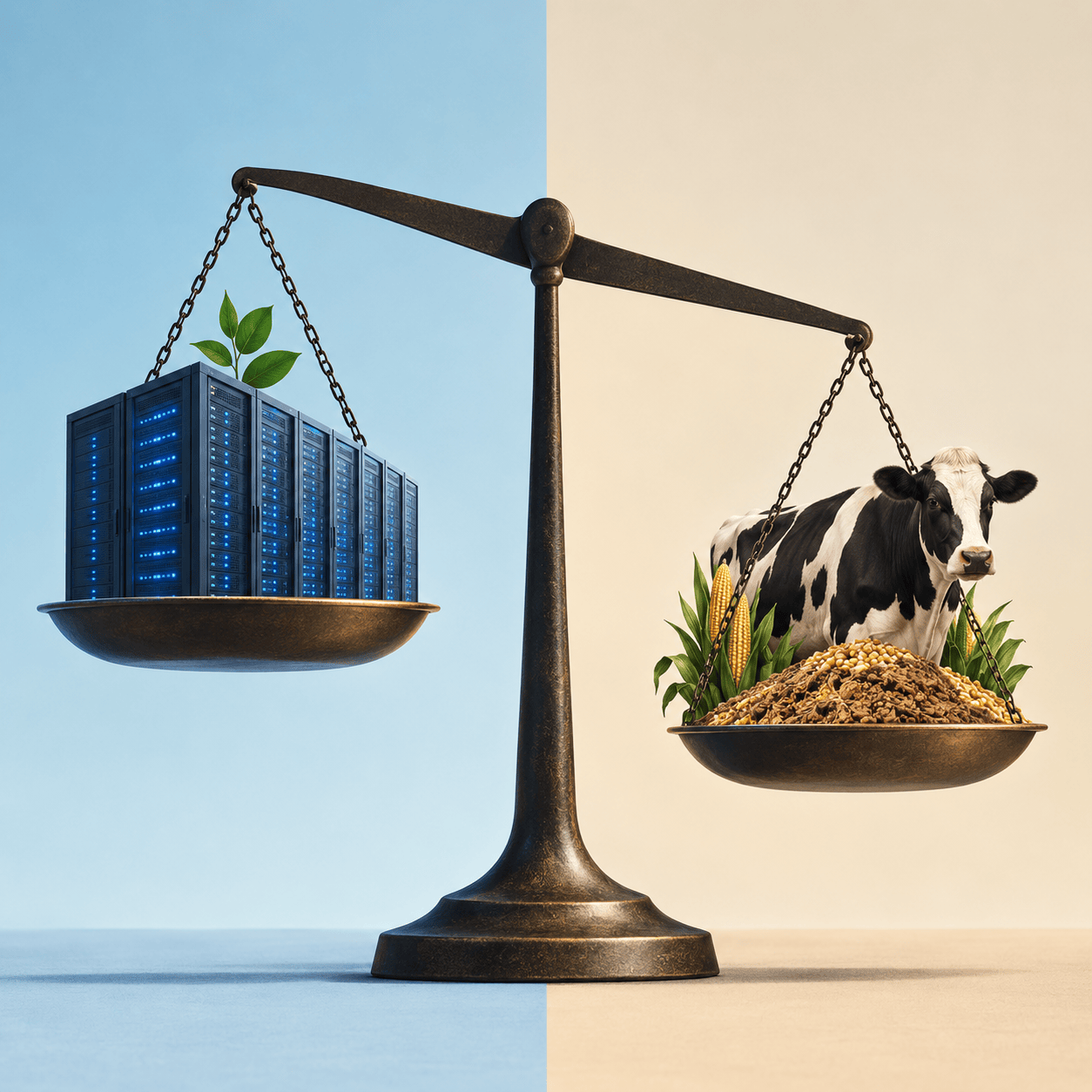
Across the country, communities are debating whether to permit data centers because they consume electricity, require water, and occupy land. Critics warn that artificial intelligence threatens the environment with its enormous buildings full of servers drawing power from the grid and water from local supplies. The pattern is familiar: A legitimate environmental concern becomes a simplified media narrative, politicians discover an easy target in Big Tech, and the public can end up adopting the conclusion without examining the underlying tradeoffs or context.
Some of these concerns are legitimate. Communities deserve to know what new facilities will consume, and companies should be required to minimize their environmental footprint. But before we condemn an industry that has the potential to revolutionize medicine, massively increase productivity, and accelerate scientific discovery, we should ask a more fundamental question: What are we getting in return?
Data centers do far more than run chatbots. They provide the computing power increasingly used for scientific research, drug discovery, medical imaging, engineering, weather forecasting, and artificial intelligence. Modern medicine, in particular, is becoming inseparable from advanced computing. Moderna and Merck’s personalized mRNA treatment for melanoma, for example, relies on identifying mutations in an individual patient’s tumor and designing a treatment around them. That kind of personalized medicine depends upon enormous amounts of sequencing, computation, and bioinformatics.
The point is not that a particular data center “cured cancer.” The point is that computational infrastructure is becoming part of the machinery through which scientists develop treatments that were unimaginable a generation ago. We don’t yet know what the next decade of computing will make possible.
But if environmental responsibility is a standard, the media, politicians, and public should apply it consistently. Because there is another industry whose environmental footprint is vastly larger—and we rarely discuss it with anything approaching the same urgency.
Animal agriculture.
Consider water. A major global assessment estimated the water footprint of animal production at approximately 640 trillion gallons annually, with 98 percent of that footprint coming from producing animal feed. By comparison, Lawrence Berkeley National Laboratory estimates that all U.S. data centers could consume roughly 37 to 74 billion gallons annually by 2028.
The figures aren’t perfectly comparable—the two estimates measure different things and operate at different scales—but the disparity is nevertheless enormous.
And water is only the beginning. Livestock occupies roughly 80 percent of agricultural land when grazing land and land used to grow animal feed are combined, yet meat and dairy provide only about 17 percent of the world’s calories. We devote vast amounts of land, water, and crops to feeding animals rather than using those resources to produce food directly for human consumption. It is an extraordinarily resource-intensive way to produce food.
Then come the consequences: greenhouse-gas emissions, nitrogen and water pollution, habitat destruction, and biodiversity loss. Much of the land we have cleared for agriculture exists to graze animals or grow food for them.
And then there is the uncomfortable health dimension. The World Health Organization’s cancer research agency classifies processed meat as carcinogenic to humans and red meat as probably carcinogenic. IARC notes that the Global Burden of Disease Project estimates that diets high in processed meat are responsible for roughly 34,000 cancer deaths worldwide each year.
Thus, the argument over data centers in isolation does not hold water.
A technology that consumes water and electricity while building computational infrastructure for medicine, science, and innovation has become an environmental villain. An industry that consumes extraordinary quantities of water, land and crops, produces pollution and greenhouse gases, contributes to habitat destruction and produces foods that include scientifically established carcinogens remains largely unquestioned as an ordinary part of modern life.
The sequence of events is not new. A legitimate question about the environmental cost of AI becomes a headline about the “water-hungry” data center. The headline becomes a social-media talking point. Politicians discover that attacking a giant technology company is easier than explaining the complicated tradeoffs of energy infrastructure. Environmental concerns become political theater. And before long, the public is echoing the conclusion as though it were self-evident.
Meanwhile, almost nobody asks the obvious question: Compared with what?
That question should be at the heart of environmental policy.
This doesn’t mean data centers should get a free pass. Developers should disclose water consumption, invest in efficient cooling, pay their fair share of infrastructure costs and avoid putting unsustainable demands on communities. If a facility threatens a region’s water supply, residents have every right to object.
But where is the same scrutiny when we approve another enormous livestock operation? Where is the outrage over the water required to grow feed? Where is the debate over land devoted to grazing and animal feed? Where is the same concern about manure, nitrogen pollution, greenhouse gases, habitat destruction, and the health consequences of consuming animal products?
If we genuinely believe that industries must justify the resources they consume, then let’s have that conversation. But morality isn’t morality when we apply it only to the industries we find convenient to criticize.
The environmental debate should be about costs, benefits and alternatives—not about whichever industry happens to be politically convenient to attack. Data centers consume resources, but they also produce computational capacity that can be used again and again to advance medicine, science, engineering, and human knowledge.
Animal agriculture consumes resources on an extraordinary scale to produce food that, in many cases, could be produced with dramatically less land and resource use by growing crops for direct human consumption. Its environmental and public-health costs aren’t some unfortunate side effect of the system. They are built into the system.
So by all means, scrutinize the data centers. Demand efficiency and accountability. Demand that companies pay the true cost of the infrastructure they use.
But if you are going to tell the world that water, electricity, land, and environmental impact are moral questions, then you don’t get to make an exception for the food on your own plate.
If you care about the water, stop eating animals. If you care about the land, stop eating animals. If you care about pollution, climate change, biodiversity, and preventable disease, stop eating animals. And if you refuse to confront the vastly greater environmental and health costs of animal agriculture while condemning data centers for their resource consumption, you aren’t consistently applying an environmental principle—you are defending a preference.


Thank you for this, K.
Perspective is critical if we want to save the planet.
Nothing is more important than reducing/quitting meat consumption – especially products that come from ruminants (beef, lamb, dairy).
James