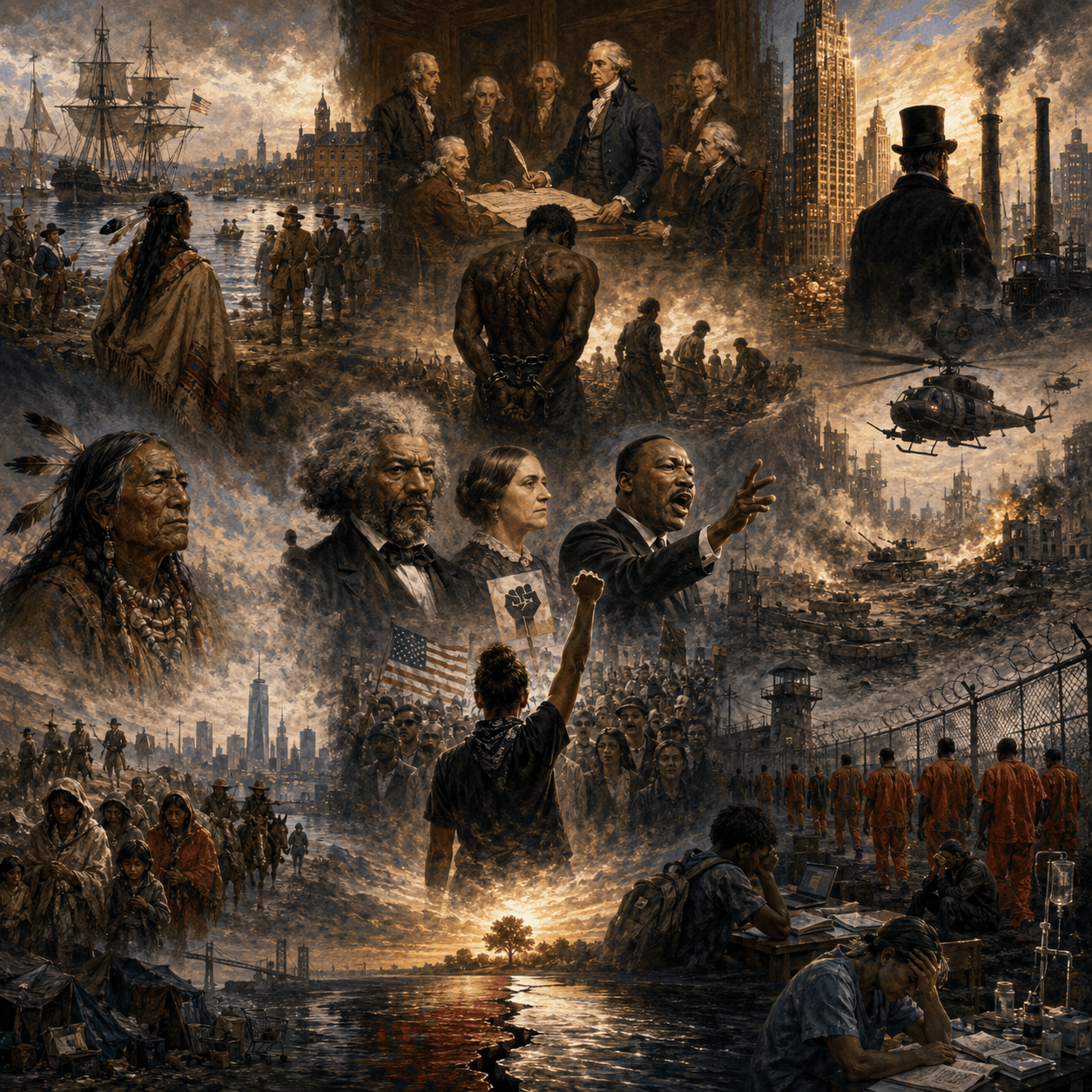
As America marks its 250th anniversary alongside New York’s 400th year since Dutch colonizers established New Amsterdam, the nation is once again laundering its blood-soaked history through a lens of blind celebration. We are told these milestones mark the birth of liberty and the world’s greatest metropolis, but this romanticized narrative requires a deliberate aversion to morality and truth. In reality, these anniversaries commemorate the opening chapters of a centuries-long campaign of violent displacement, broken treaties, and the systematic erasure of the Lenape people from their ancestral homeland. A mature society demands more than historical myth-making. It requires that we face exactly what we are celebrating, and name the immense human cost at which it came.
The comforting narrative of the American story positions its history as a series of inspiring achievements occasionally marred by unfortunate contradictions. But a closer look reveals that these contradictions were never bugs in the system—they were features. Two hundred and fifty years ago, fifty-six white men signed a Declaration proclaiming that “all men are created equal” while nearly one in five people in the colonies were held in chattel slavery. The men demanding freedom from British tyranny were actively denying basic human existence to the people they owned. This white supremacy was not a tragic footnote; it was baked directly into the nation’s economic and legal foundations.
When the Civil War finally ended slavery, it did not birth true freedom. Instead, the nation pivotally chose to replace it with nearly a century of state-sanctioned racial terror, segregation, voter suppression, and legalized discrimination, all while Native nations were systematically forced from their lands through coercive treaties and state-sponsored violence. The history of American liberty is not a story of steady, natural expansion. It is a history of a dominant class deciding, over and over again, who was human enough to be entitled to it.
These foundational fractures are hardly confined to the past; they directly shape our current crises. An empire that boasts of being the wealthiest in human history actively tolerates a reality where a child’s quality of education is dictated by their zip code, and where millions remain uninsured or crushed by medical debt. Our economic structure has generated unfathomable prosperity for a select few, producing a grotesque level of inequality where a handful of billionaires possess more wealth than entire nations, while millions of overworked, underpaid Americans face severe food insecurity. This disparity is enforced by a predatory criminal justice system that incarcerates its citizens at rates far higher than any other developed democracy, functioning as an engine of punishment and generational trauma rather than rehabilitation.
This pattern of internal exploitation matches America’s projection of power abroad. Under the guise of defending global freedom and democracy, the United States has repeatedly used its unmatched military apparatus to destabilize foreign nations for its own strategic and economic interests. The 2003 invasion of Iraq—launched on fabricated assertions of weapons of mass destruction—stands as one of the most catastrophic foreign policy decisions of the modern era. That single choice resulted in the deaths of hundreds of thousands of Iraqi civilians, displaced millions more, cost the lives of thousands of American service members, and squandered trillions of dollars. Yet the lesson remains unlearned. Today, we watch that same tragic blueprint unfold as the nation squanders an additional $200 billion on an unjustified, rudderless war in Iran. As these billions flow into defense contracts while domestic infrastructure crumbles and social safety nets are stripped bare, we must face the reality that America’s global posture has long prioritized military hegemony over the genuine well-being of people at home and abroad.
Compounding these failures is a profound lack of national humility, laid bare by American leaders who constantly refer to the United States as the best, wealthiest, and most powerful nation on earth. This relentless self-congratulations completely ignores the reality that we are drowning in national debt, recklessly abusing our military power, and falling behind other countries that perform far better in key areas of society. A truly secure nation would project humility and leave it to others to judge its success. By constantly declaring ourselves the best since the dawn of time, we send a message to the world of arrogant exceptionalism rather than a genuine commitment to self-reflection, progress, and ownership of our transgressions.
This blindness and lack of compassion extend outward to the natural world, encompassing centuries of horrifying cruelty toward non-human life. In the shadow of our corporate progress lies the animal agriculture industry, an apparatus of violence that relies on the needless confinement, systematic torture, and slaughter of untold trillions of sentient beings over our history. This systemic violence is intimately linked to the country’s disproportionate impact on global warming and climate change, a crisis driven by unsustainable consumption and a profound refusal to accept responsibility for our obligation to future generations. True maturity demands that we look honestly at these acts of ecological and ethical devastation rather than hiding behind empty patriotic rituals.
If there is anything worth salvage in this experiment, it is not the myth of a perfect founding, but the legacy of the dissidents who weaponized the nation’s hypocrisies against it. The true architects of American progress were never the presidents or the tycoons, but the radicals and outcasts who forced concessions from a reluctant power structure. It was Frederick Douglass exposing the cruelty of the Fourth of July to an enslaved population; Susan B. Anthony demanding that liberty include women; and the Rev. Martin Luther King Jr. exposing the moral bankruptcy of American capitalism and militarism. If we are to look at these anniversaries with thoughtfulness, we must completely reject the temptation of historical amnesia. We must center the Lenape, the millions who survived chattel slavery, the Japanese Americans forced into wartime internment camps, and the countless civilians caught in the crosshairs of American imperialism.
Ultimately, a mature nation does not comfort itself with fairytales. It confronts its failures and seeks to remedy them. The purpose of an anniversary should not be to congratulate ourselves on a romanticized past, but to reckon honestly with the ongoing damage of that past. As the fireworks burst overhead—terrorizing wildlife, traumatizing domesticated animals, and triggering veterans with PTSD—the most genuinely patriotic act we can perform is to refuse the simple, sanitized story of America. It has been a nation built on grand promises and brutal betrayals, visionary ideals and devastating violence. The measure of this project is not whether it was ever great, but whether we are willing to do the uncomfortable, disruptive work required to dismantle its systemic injustices today.
As we watch billions burn overseas in yet another meritless war—money that could have been used to address our most pressing challenges—we are left staring into the sky at an illusion intended to distract us from reality. What, exactly, are we celebrating? If America truly wants to be the envy of the world, we should end empty pageantry and transform this milestone into a nationwide reckoning on how we can fundamentally repair our nation and our relationship to the world.


