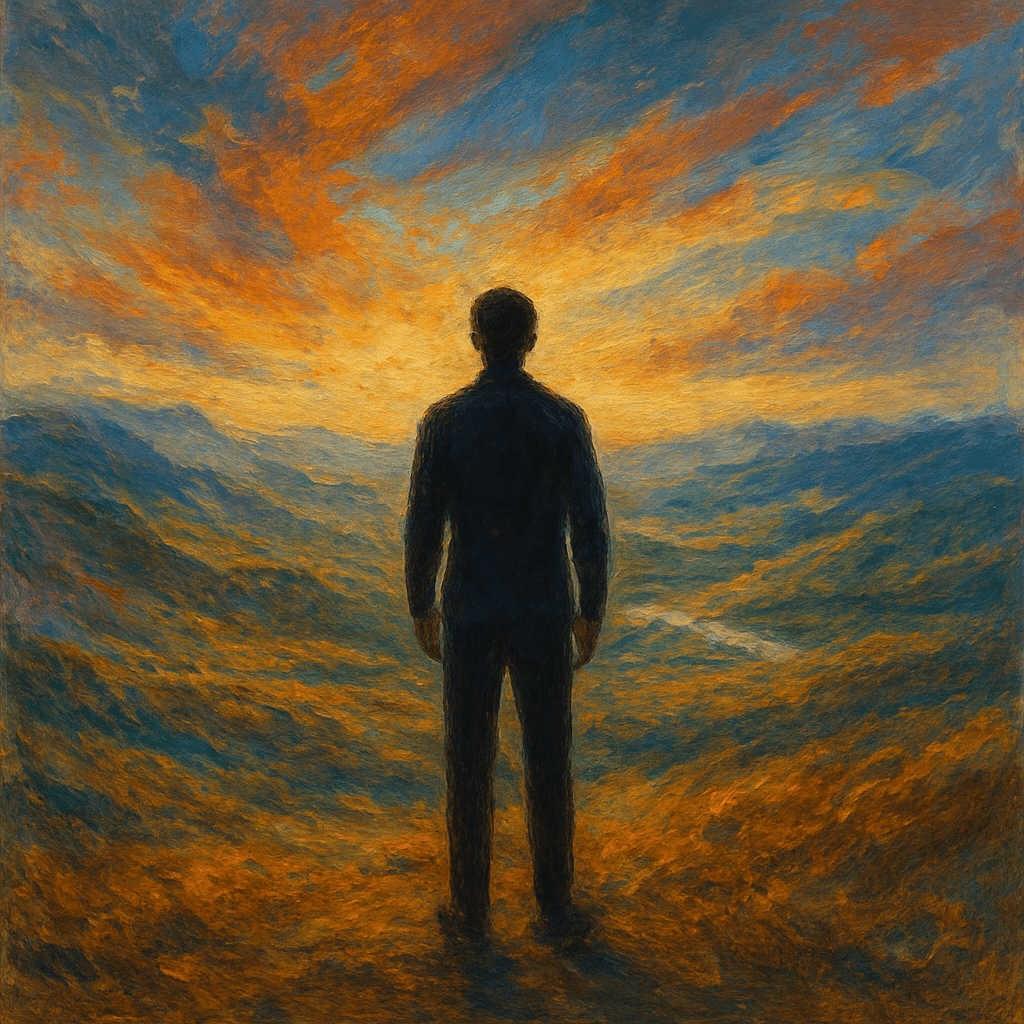
Human history stretches far beyond what we can write down or remember—long before monuments, kingdoms, or empires. For more than 300,000 years, Homo sapiens have wandered this planet, long before cities, farming, or the first cave paintings. To understand who we are today, it helps to look across this immense landscape of time. In doing so, we see our fragility and our astonishing resilience—and we face an old question with new urgency: can the lessons of our past guide us toward a better future?
The first known humans, whose fossils were found in Morocco, lived roughly 315,000 years ago. They survived in small, nomadic groups on the African savanna, bound by kinship and necessity. Life was short and uncertain. Illness, predators, and hunger kept the human population small—likely under a million people on Earth for thousands of years. But they endured. They learned to make tools, tame fire, and speak to one another. These were revolutions which allowed our ancestors to survive droughts, cross continents, and imagine possibilities beyond the horizon. By 50,000 years ago, humans had reached Australia; by 15,000 years ago, they stood on the soil of the Americas. Even in places we now call “new,” others had lived and dreamed for millennia.
Around 40,000 years ago, something extraordinary happened. Humans began to create art—not for survival, but for meaning. They painted animals on cave walls, strung beads, carved figures from bone. It was more than decoration; it was storytelling. This “creative explosion” marked a shift from mere existence to imagination. Through shared symbols and myths, we learned to cooperate on a larger scale. Culture became our greatest survival skill.
For most of our history, humans lived as hunter-gatherers. They moved from place to place following the seasons and the availability of food and water. Then, about 12,000 years ago, came the Agricultural Revolution—a turning point that reshaped everything. In the Fertile Crescent, China, and the Americas, people began to plant seeds, raise animals, and stay in one place. Villages became towns, towns became cities, and food surpluses gave rise to new classes—rulers, soldiers, priests. Writing appeared, not to record poetry, but to track crops and taxes. With civilization came great achievements—mathematics, law, architecture—but also inequality, slavery, and war. Humanity had learned not just how to cultivate the land, but how to control each other.
In the next 5,000 years, empires rose and fell across the globe. The Persians built roads that stretched for thousands of miles. The Romans spread law and engineering across Europe. The Han dynasty refined bureaucracy and science. In Africa, the Americas, and the Pacific, civilizations flourished with their own systems of art, astronomy, and philosophy. Trade routes like the Silk Road linked distant worlds, carrying not only silk and spices, but religions, technologies, and disease. Every encounter—peaceful or violent—reshaped the human experience.
Then came the acceleration. In just the last 500 years, the pace of change exploded. The Scientific Revolution replaced superstition with inquiry. The Enlightenment taught us to question authority and imagine liberty. The Industrial Revolution unleashed the power of steam, electricity, and machinery. Humanity gained the ability not just to adapt to nature, but to dominate it. Populations soared, cities swelled, and medicine extended our years. But progress came with its own shadows: exploitation, colonialism, and the destruction of ecosystems that had sustained us for millennia.
If all of human history were compressed into a single day, written history would appear only in the final few minutes. The past century—the age of world wars, nuclear power, and the internet—would flash by in seconds. Yet, in those seconds, we have reshaped the Earth more profoundly than all previous ages combined. We’ve built machines that think, cities that never sleep, and networks that connect billions of people across continents. We’ve cured diseases that once devastated whole populations. But we’ve also heated the planet, polluted our oceans, and armed ourselves with weapons capable of ending it all.
Nearly eight billion people now share this fragile sphere. We face crises that no single nation can solve alone: climate change, inequality, political division, and the struggle to coexist. But we also possess tools that no generation before us has ever had—instant communication, vast scientific understanding, and the capacity to act collectively on a global scale.
What can 300,000 years of human history teach us? First, perspective. For most of our existence, survival meant nothing more than finding food, warmth, and shelter. The things we take for granted—running water, air conditioning, vaccines, transportation—would have been unimaginable luxuries to almost everyone who came before us. This reality should keep us grounded and grateful as it reminds us that our most ordinary days are extraordinary in the context of history.
Second, humility. History is not a steady climb upward. Civilizations collapse. Democracies fall. Knowledge is forgotten. Progress is fragile. The same traits that make us inventive—ambition, pride, desire—can also hasten our downfall. No society has ever been immune to its own complacency, poor judgment, or hubris. That truth should compel us to question our assumptions, challenge our norms, listen before judging, and value learning above certainty. We must join forces to solve problems, admit mistakes openly, and have the courage to change course.
But perhaps the greatest lesson of all is possibility. The same creative spark that painted on cave walls now creates meat from plants and cures diseases. The same adaptability that let us survive the Ice Age can help us face climate change. Common narratives once bound tribes and nations together; today, we need new ones—stories of stewardship, empathy, and unity on a planetary scale.
Each generation must rediscover the will to see beyond its own reflection and create meaning that includes others. This does not happen by accident but through deliberate effort—by teaching empathy as deeply as we teach math, by holding leaders accountable to truth, and by telling stories that celebrate cooperation as much as competition.
We are the latest chapter in a story 300,000 years long—a story of struggle, invention, and imagination. Our ancestors endured famine and war, plague and empire. They stumbled, adapted, and brought us to this moment. Now it is our turn to decide what kind of ancestors we will be. Each day, in how we live, what we build, and how we use our limited time, we shape that legacy. One day, history will write our story. Our task is simple but profound: to become better ancestors for the billions yet to be born.
Andrew Kirschner is the founder of Epic Walking Tours in New York City.

 Kirschner's Korner
https://www.pbs.org/wgbh/nova/series/human/