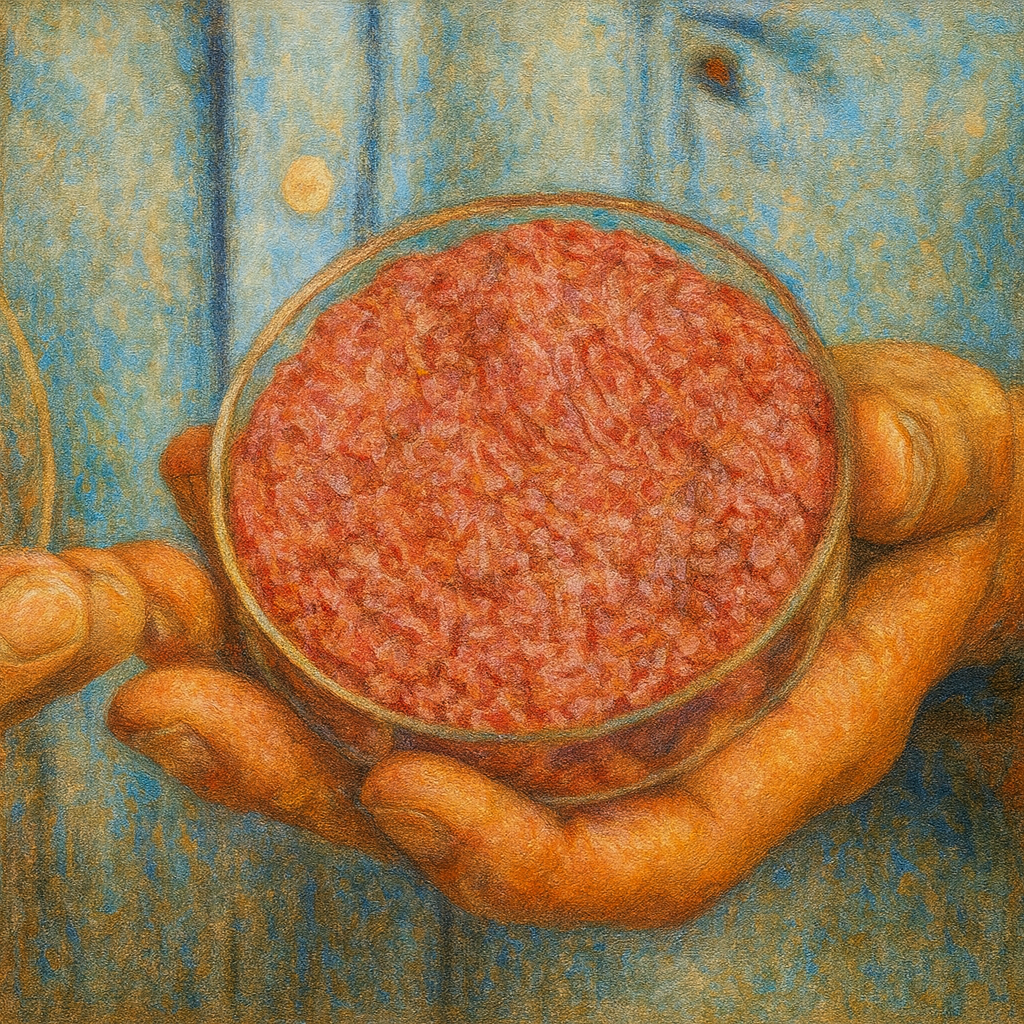
The first cultivated meat products will not arrive with a technological flourish. They will arrive quietly—perhaps as a familiar cut of chicken, or as an ingredient blended into a meal most people already eat. And yet their significance may rival some of the most consequential advances in the history of food.
Cultivated meat—real meat grown from animal cells without raising or slaughtering animals—forces a question that has become harder to avoid: must feeding ourselves require so much suffering, waste, and environmental damage?
Modern animal agriculture is extraordinarily effective at one thing: producing large quantities of meat at low apparent cost. But that efficiency is an illusion. It is built on an underlying system that confines billions of animals in conditions most people would find deeply disturbing, consumes enormous amounts of land and water, emits vast quantities of greenhouse gases, and converts edible crops into animal feed with staggering inefficiency. We grow mountains of corn and soy not to feed people, but to feed animals who return only a fraction of those calories and proteins in the form of meat.
The harms are not abstract. In the United States alone, tens of billions of animals are raised and killed each year, most in intensive confinement systems that severely restrict movement and natural behavior. Globally, livestock production is a major driver of deforestation, biodiversity loss, and climate change. It also relies heavily on antibiotics, contributing to the rise of drug-resistant bacteria that threaten human health. These costs are externalized—borne by animals, ecosystems, and future generations rather than reflected in the price of meat at the store.
At the same time, demand for meat continues to rise worldwide. Billions of people want more of it, not less. Asking everyone to abandon meat has not worked and is unlikely to work at the scale or speed the moment demands.
Cultivated meat offers a different approach: not changing what people eat, but changing how it is made.
By growing meat directly from animal cells, cultivated meat bypasses many of the most harmful steps in the current system. It does not require raising and slaughtering animals. It does not require vast feed crops or concentrated animal waste. And because the process is far more direct—turning nutrients into meat without an entire animal as the intermediary—it holds the promise of a far more efficient use of resources.
This is not science fiction. Cell culture is a well-established technology used to make vaccines, medicines, and essential food ingredients. What is new is applying it to meat itself. The remaining challenges are economic and political, not scientific.
That political resistance is already visible. In recent years, several states, including Florida and Alabama, have moved to ban or restrict cultivated meat outright—before it has even reached consumers at scale. The stated justifications vary, but the underlying logic is familiar: protect incumbent industries from competition, stoke cultural anxiety about change, and frame innovation as a threat rather than an opportunity.
These bans are not about food safety; cultivated meat is regulated under existing federal frameworks. They are not about consumer choice; they eliminate it. Instead, they reflect the power of a status quo that benefits from keeping the current system intact, even as its harms grow harder to defend.
The irony is that cultivated meat does not need to replace conventional meat to matter. Even partial adoption—particularly in the most resource-intensive segments of production—could significantly reduce animal suffering and environmental damage. It is a complement, not a demand for purity.
So what would it look like to take this possibility seriously?
Policymakers could invest in research, pilot facilities, and open-access science, just as they have with other technologies deemed important to national resilience. Regulators could provide clear, science-based pathways that ensure safety without slowing progress to a crawl. Public institutions—from schools to hospitals—could be prepared to adopt new options as they become viable, helping drive scale and affordability.
Consumers, meanwhile, do not need to become evangelists or early adopters. They can start by resisting misinformation, supporting evidence-based policy, and recognizing that improving how meat is made is not an attack on culture or tradition, but an evolution of it.
The question cultivated meat ultimately raises is not whether it will single-handedly fix our food system. The question is whether, when faced with a system that causes immense and unnecessary harm, we are willing to explore credible alternatives—or whether we default to defending what is familiar simply because it exists.
Future generations are unlikely to judge us by whether we perfected any single innovation. They will look instead at whether we recognized the costs of our choices and responded with seriousness and care. They will ask whether we noticed that feeding ourselves had become one of the most destructive things we do, and whether we tried—imperfectly, pragmatically, but earnestly—to do better.
Cultivated meat will not decide the future of food on its own. But our willingness to give it a fair chance will say a great deal about how we confront suffering, inefficiency, and change—especially when the victims are mostly out of sight, and the short-term convenience of the status quo shields us from seeing its true costs.

 Kirschner's Korner
I first learned about cultivated meat almost 10 years ago. I have patiently been waiting for it to come to fruition. Thank you for writing this detailed article explaining the various aspects involved.
“Future generations are unlikely to judge us by whether we perfected any single innovation. They will look instead at whether we recognized the costs of our choices and responded with seriousness and care.”
100%. As the American educator and philosopher John Dewey said (I’m paraphrasing), we need to consider all the effects of our behavior and keep trying to make better choices.