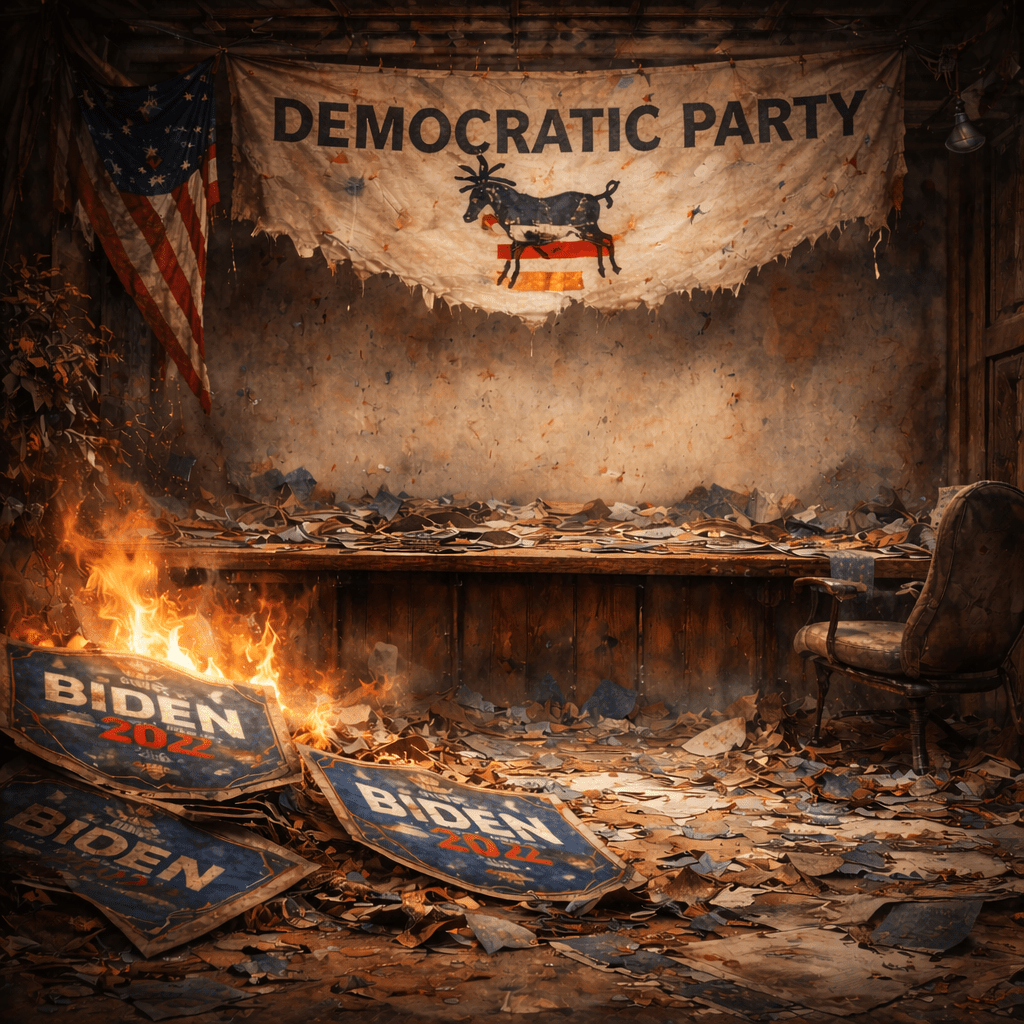
The political ascent of Joe Biden stands as one of the most improbable trajectories in American history, a story defined not by a groundswell of popular inspiration but by the strategic “safeness” of a political establishment more terrified of internal revolution than external defeat. To understand how Biden “happened” is to trace the tracks of a man who spent nearly four decades as a punchline for failed presidential ambitions.
In 1988, his campaign imploded following a scandal where he was caught plagiarizing a speech by British Labour leader Neil Kinnock and found to have inflated his academic record, claiming he graduated in the top half of his law class when he was actually 76th out of 85. Twenty years later, in 2008, he garnered a humiliating 1% of the vote in the Iowa caucus–the primary state most associated with his brand of politics. He was, by all accounts, a man whose time had passed before it ever truly arrived.
In nearly four decades in the halls of the Senate, Biden’s legislative record was defined less by visionary statesmanship and more by a reflexive adherence to the prevailing—and often later regretted—political winds. He functioned as a reliable creature of the establishment, lending his name to “achievements” that have since become millstones around his party’s neck, most notably the 1994 Crime Bill which fueled the mass incarceration he later spent a presidency apologizing for.
Beyond authorship of punitive domestic policy and a career-long penchant for bloviating in committee hearings, his tenure was marked by a lack of signature, transformative lawmaking; he was a deal-maker for the sake of the deal, often compromising away core principles to remain a “man of the Senate” while more courageous colleagues took the actual risks of leadership. He voted for the Iraq War authorization. He also championed the 2005 bankruptcy overhaul, a bill long criticized for tightening relief for struggling families while benefiting credit card companies headquartered in his home state. He was a perennial passenger on the train of history, rarely the conductor, leaving behind a trail of middle-of-the-road legislation that addressed the symptoms of American decline without ever daring to challenge the systemic rot of the status quo.
His path to the White House began not with a grassroots mandate but as a specific utility to Barack Obama. In 2008, the young Senator from Illinois needed a “safety rail”—a veteran of the Senate Foreign Relations Committee who could reassure working-class voters in the Rust Belt and offset fears of his own inexperience. Yet, this partnership was one-sided; when 2016 arrived, the establishment, with Obama’s tacit approval, threw its weight behind Hillary Clinton. Biden was sidelined, told his time for mourning his son Beau was a convenient exit ramp for a party that had already anointed its next successor.
The “Biden Miracle” of 2020, made possible by COVID forbidding him from a campaign trail, was a case study in consolidation. After placing fourth in Iowa and fifth in New Hampshire, the party’s “invisible primary” went into overdrive. Fearing a Bernie Sanders nomination because the party could not recruit better quality candidates with general election appeal, the establishment orchestrated a tactical strike: Pete Buttigieg and Amy Klobuchar, both more agile and younger, were pressured to get off the railroad tracks and endorse Biden on the eve of Super Tuesday. It was an anointment of the only train car left standing.
This rise required the media and the party to overlook a litany of red flags that would have sunk any other candidate. From the grotesque and inexcusable physical boundary issues raised by women like Lucy Flores to the “gaffe machine” persona that masked a diminishing edge, Biden was shielded by a reality distortion field. The “Uncle Joe” brand was used to sanitize aggressive outbursts—such as telling a voter “you’re a damn liar” or challenging Donald Trump to a physical fight—while controversies surrounding his son Hunter Biden were often treated as peripheral or politically inconvenient. His long history of verbal misstatements—once shrugged off as harmless—took on new significance as concerns about age and acuity grew more difficult to dismiss. The most critical failure, however, was the betrayal of his 2020 promise to be a “bridge” or “transitional figure.” Instead of honoring that implied vow to hand the keys to a younger generation, Biden’s inner circle of handlers—driven by ego, power, and a refusal to acknowledge the physical and cognitive toll of the office—systematically cleared the 2024 field.
By refusing to step aside in early 2023, Biden’s handlers committed an unforgivable strategic error. They signaled to rising stars that any challenge would be viewed as a betrayal, effectively suppressing a natural, competitive primary that would have battle-tested a more competent successor. U.S. Representative Dean Phillips, one of the few credible challengers, faced pressure to drop out, illustrating a striking hypocrisy: the same Democratic Party that decried Republican attempts to subvert democracy by limiting voter influence actively manipulated its own process to protect an incumbent.
This is not merely a story about one campaign’s miscalculation; it is an indictment of a political process that increasingly discourages newcomers and risk, rewards incumbency above all else, and substitutes elite coordination for voter choice. These handlers managed Biden’s schedule and limited unscripted interactions to mask a decline that became undeniable during the June 2024 debate. By the time the pressure became insurmountable and Biden withdrew on July 21, 2024, the democratic process had already been meaningfully constrained. The party was forced into an emergency, Hollywood- and media-driven coronation of Kamala Harris without a single primary vote cast for her at the top of the ticket. She was not merely a beneficiary of this process but a participant in it, choosing loyalty to the existing power structure over a timely, transparent transition that would have better served the electorate.
This outcome did not occur in a vacuum. It reflects a broader erosion of democratic competition in American politics, where the “invisible primary”—donor networks, endorsements and media signaling—often matters more than the votes themselves. It reflects a system in which party leaders quietly decide viability, where challengers are deterred before campaigns even begin, and where voters are presented with outcomes that feel predetermined. It reflects a media ecosystem that too often confuses access with scrutiny, softening coverage for those within the system while sharpening it for outsiders. And it reflects a culture of gerontocracy, in which leadership is hoarded rather than renewed, even as the demands of the office grow more complex and unforgiving.
Biden’s final act was not simply a misjudgment; it was a dereliction. By clinging to power long after the limits of age and circumstance had become evident, he subordinated the interests of the country to his own sense of indispensability. The delay in stepping aside did not merely complicate a campaign—it foreclosed a legitimate democratic process, denied voters a meaningful choice, and left his party scrambling to manufacture consensus where competition should have existed.
For a president who framed his candidacy as a defense of democratic norms, the contradiction is stark: when tested, he preserved his position, not the process. His legacy, then, is not one of steady stewardship but of managed decline and hypocrisy—an administration defined by caution, insularity, and an unwillingness to confront its own limitations. The consequences of that failure will not be confined to a single election cycle; they will reverberate for years, shaping the country’s political trajectory, weakening public trust, and burdening future generations with the consequences of a moment when leadership chose self-preservation over responsibility.

 Kirschner's Korner